
Inherited IRA Trusts, the SECURE Act, and Spendthrift Trusts: Protecting a Child Without Creating an Income Tax Nightmare
One of the most difficult conversations in estate planning has nothing to do with taxes; it has everything to do with protecting the people we love. Many parents have adult children who are hardworking and financially responsible. They may also have another child who struggles with money management, untrustworthy spouses, creditor problems, addiction, gambling, alcoholism, or mental illness. Any one of these issues can affect financial judgment or cause a person to make poor financial decisions. These parents are often caught between two competing goals: they want to leave that child an inheritance, but they also know that handing over a large sum of money outright could be devastating. It's even more difficult when a large part of their estate is in retirement accounts like IRAs, 401(k)s, or similar qualified retirement plans that traditionally, without careful estate planning, transfer directly to the beneficiary as a lump sum.
In many cases, a properly designed spendthrift trust or discretionary trust can provide the protection a vulnerable beneficiary needs, but when the inheritance includes a large Traditional IRA, families also have to consider the SECURE Act's income tax rules for inherited retirement accounts. Understanding how these rules work can save a family hundreds of thousands of dollars (or even more) in unnecessary taxes while still protecting a beneficiary from creditors and from his or her own poor decisions.
A Common Estate Planning Scenario
Assume a parent owns a $4,000,000 Traditional IRA. This parent has two children inheriting equal shares, so each child will ultimately inherit approximately $2,000,000. One child is financially responsible, but the other has experienced a lifetime of creditor issues, poor money management, and impulsive spending.
The parent does not want the child with money troubles to receive his inheritance outright. Instead, she wants a professional trustee to manage the inheritance through a discretionary spendthrift trust. She wants distributions limited to the son's health, education, maintenance, and support (commonly referred to as the "HEMS standard.") She also wants the trustee to have discretion over whether distributions should actually be made.
This type of planning is commonly accomplished through an "accumulation trust," sometimes referred to as a "retirement benefits trust." The original SECURE Act, passed in 2019, generally requires that most inherited IRAs left to adult children be fully distributed within 10 years. SECURE Act 2.0 and the IRS's 2024 final regulations added an important layer to this rule: if the parent dies on or after her own required beginning date for RMDs, the trust must also take annual distributions during years one through nine, not just empty the account by year ten. One point that many people misunderstand is that the law requires distributions to come out of the inherited IRA, but it does not require those distributions to be immediately paid from the trust to the beneficiary. That distinction is what allows an accumulation trust to provide meaningful creditor protection.
How an Accumulation Trust Works
Each year, the trustee receives a distribution from the inherited IRA. The trustee then decides whether those funds should be paid out to the beneficiary or retained inside the trust. The tax consequences depend entirely upon what the trustee decides to do with each distribution. For purposes of the examples that follow, assume the following:
Son's inherited IRA: $2,000,000
Son's annual salary: $60,000
Filing status: Single
Annual IRA distribution: $180,000
State income taxes: Ignored for simplicity
Trust type: Non-grantor accumulation trust
Tax year / rates used: 2025 federal brackets
(These figures are illustrative estimates only, using 2025 federal tax brackets and assuming the amounts shown are already net of any deductions. They ignore state income tax, the Net Investment Income Tax, and other individual circumstances. Actual results will vary and should always be modeled by a qualified tax professional.)
Scenario 1: The Trustee Distributes Everything
Suppose the trustee receives a $180,000 distribution from the inherited IRA and immediately distributes the entire amount to the son.
Son Salary = $60,000
Trust distribution = $180,000
Total taxable income = $240,000
Estimated federal income tax = Approximately $53,800
Trust income tax = $0
Because the trust distributes all of its taxable income, the trust generally receives a deduction for that distribution. The taxable income is carried out to the son through a Schedule K-1, and he pays the income tax at his individual income tax rates. From a tax perspective, this is generally the most efficient result. From an asset protection perspective, however, it is often the least desirable, because the money is now in the son's possession, where it may become available to creditors or be quickly spent.
Scenario 2: The Trustee Distributes Only Part of the IRA Distribution
Suppose instead that the trustee distributes only $40,000 to the son and retains the remaining $140,000 inside the trust.
Son taxable income = $100,000
Trust taxable income = $140,000
Son estimated federal income tax = Approximately $16,900
Trust estimated federal income tax = Approximately $49,800
The combined federal income tax is approximately $66,700.
Although the overall family tax bill is somewhat higher than in the first example, the trustee has preserved most of the inheritance inside the protected trust, where creditors generally cannot reach it and where the beneficiary cannot simply withdraw it on demand. This illustrates one of the fundamental tradeoffs in estate planning: better asset protection frequently comes at the cost of higher income taxes.
Scenario 3: The Trustee Retains Everything
Now suppose the trustee retains the entire $180,000 distribution inside the trust and distributes nothing to the beneficiary.
Son salary = $60,000
Trust taxble income = $180,000
Son estimated federal income tax = Approximately $8,100
Trust estimated federal income tax = Approximately $64,600
The combined federal income tax is now approximately $72,700.
The reason for this larger tax burden is simple: trusts reach the highest federal income tax bracket after relatively little taxable income compared to individuals. In 2025, a trust hits the top 37% federal bracket at just $15,650 of taxable income, while a single individual doesn't reach that bracket until taxable income exceeds $626,350. As a result, retaining substantial IRA distributions inside a trust often causes much of that income to be taxed at the highest marginal federal income tax rates.
Does the Beneficiary Pay Tax Again Later?
Fortunately, the answer is generally "no." Suppose the trust receives a $180,000 IRA distribution, pays approximately $64,600 in income tax, and retains approximately $115,400. Five years later, the trustee distributes that $115,400 to pay for the son's medical care. That distribution is generally considered a distribution of principal that has already been taxed. The son does not generally pay income tax again merely because those funds are later distributed. Any investment income earned while those funds remain inside the trust, however, will continue to be taxed under the normal trust income tax rules.
Why Good Trustees Rarely Choose All or Nothing
An experienced professional trustee rarely views these decisions as all-or-nothing choices. Instead, the trustee evaluates the beneficiary's income, financial circumstances, creditor exposure, and actual needs each year. If the beneficiary is in a relatively low income tax bracket, the trustee may distribute additional funds to take advantage of lower individual tax rates. If creditor protection is the greater concern, the trustee may retain more assets despite the higher trust income taxes. This flexibility is one of the greatest strengths of an accumulation trust.
Can the Trustee Convert an Inherited IRA Into a Roth IRA?
No. This is one of the most common misconceptions involving inherited IRAs. Once the parent dies, neither the trustee nor the son can convert an inherited Traditional IRA into a Roth IRA. Federal tax law simply does not permit a non-spouse beneficiary to make a Roth conversion of an inherited IRA. Once death occurs, that planning opportunity has disappeared.
Why a Lifetime Roth Conversion Can Be a Powerful Estate Planning Tool
A perhaps better planning opportunity can occur while the IRA owner is still living. Suppose the parent converts her Traditional IRA into a Roth IRA before her death and pays the resulting income tax using assets outside the retirement account. When she later dies, the trust inherits a Roth IRA rather than a Traditional IRA. The SECURE Act rules generally still require the inherited Roth IRA to be distributed within 10 years; however, assuming the Roth satisfies the applicable requirements for qualified distributions, those distributions are generally income tax free. The difference can be dramatic.
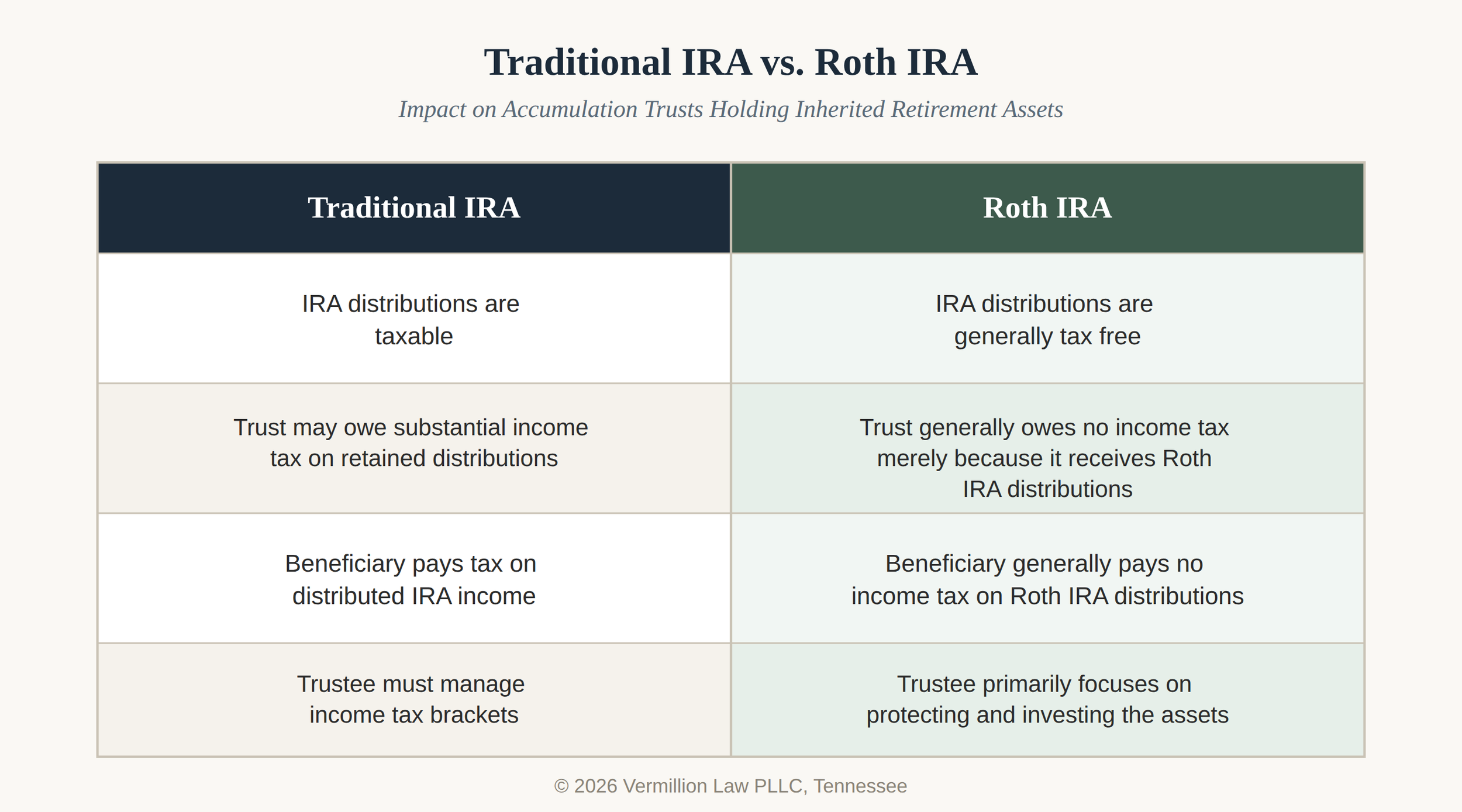
Doing a Roth IRA conversion before death might be an excellent way to manage your beneficiaries’ inheritances, even after you’re gone.
For families using accumulation trusts, a carefully planned lifetime Roth conversion can substantially reduce or even eliminate the trust income tax problem that often accompanies inherited Traditional IRAs. Of course, a Roth conversion is not appropriate for every client. The decision depends upon the IRA owner's current tax bracket, expected longevity, available assets to pay the conversion tax, expected investment returns, state income taxes, charitable objectives, and the anticipated tax situations of the beneficiaries. These decisions should always be modeled carefully before proceeding.
It is also worth noting that when determining whether an estate will be liable for federal estate taxes, whether the investments are in a Traditional IRA or a Roth IRA is immaterial; all assets are combined when calculating an individual's gross estate value for federal estate tax purposes.
Estate Planning Is About More Than Taxes
Although managing income taxes is important, this is often not the primary reason parents choose to leave an inheritance in trust. Parents who have watched a child struggle with addiction, alcoholism, gambling, compulsive spending, repeated bankruptcies, or chronic financial instability understand that unrestricted access to a large inheritance may do far more harm than good. Money does not solve addiction. In many cases, it removes the financial barriers that previously limited destructive behavior. A large inheritance can finance drug purchases, alcohol abuse, gambling losses, impulsive spending, or relationships with people who are more interested in the money than in the beneficiary. In the most heartbreaking situations, unrestricted inheritances have contributed to overdoses, financial exploitation, homelessness, and even premature death.
Many parents worry that placing a child's inheritance in trust somehow communicates a lack of confidence or love. In reality, the opposite is often true. A carefully drafted discretionary spendthrift trust allows a professional trustee to ensure that housing is maintained, medical care is available, treatment programs are funded when appropriate, education can continue, and legitimate needs are met, without placing unrestricted wealth into the hands of someone who may not yet be capable of managing it safely. Sometimes the greatest gift a parent can leave is not unrestricted access to money, but protection.
Inherited IRAs, the SECURE Act, spendthrift trusts, and accumulation trusts all intersect in ways that can dramatically affect both taxes and family outcomes. For beneficiaries who have creditor issues or who struggle with financial responsibility, an accumulation trust often provides an excellent balance between protecting inherited assets and allowing the trustee to provide for the beneficiary's legitimate needs. When appropriate, lifetime Roth conversions may further improve the plan by reducing or eliminating future income taxes on inherited retirement assets while preserving the trust's asset protection benefits.
Each family's circumstances are different. The best plan is one that protects both the inheritance and the person receiving it. Good estate planning is not simply about passing wealth to the next generation; it's about making sure that wealth becomes a blessing rather than a burden. If you’d like to learn more about careful and thoughtful estate planning options, please reach out to us. We’d be happy to help.
This article is for general informational purposes only and does not constitute legal, tax, or financial advice. Tax brackets, rates, and thresholds change annually and vary by state. Anyone considering this type of planning should consult a qualified estate planning attorney and tax advisor about their specific circumstances.